1. Mars and Earth have approximately the same landmass.Even though Mars has only 15% of the Earth’s volume and just over 10% of the Earth’s mass, around two thirds of the Earth’s surface is covered in water. Martian surface gravity is only 37% of the Earth’s (meaning you could leap nearly three times higher on Mars).
2 .Only 18 missions to Mars have been successful.
As of September 2014 there have been 40 missions to Mars, including orbiters, landers and rovers but not counting flybys. The most recent arrivals include the Mars Curiosity mission in 2012, the MAVEN mission, which arrived on September 22, 2014, followed by the Indian Space Research Organization’s MOM Mangalyaan orbiter, which arrived on September 24, 2014. The next missions to arrive will be the European Space Agency’s ExoMars mission, comprising an orbiter, lander, and a rover, followed by NASA’s InSight robotic lander mission, slated for launch in March 2016 and a planned arrival in September, 2016.
3 .The Red Planet is home to both the highest mountain and the deepest, longest valley in the solar system. Olympus Mons is roughly 17 miles (27 kilometers) high, about three times as tall as Mount Everest, while the Valles Marineris system of valleys — named after the Mariner 9 probe that discovered it in 1971 — reaches as deep as 6 miles (10 km) and runs east-west for roughly 2,500 miles (4,000 km), about one-fifth of the distance around Mars and close to the width of Australia.
4 . Mars also has the largest volcanoes in the solar system, Olympus Mons being one of them. The massive volcano, which is about 370 miles (600 km) in diameter, is wide enough to cover the state of New Mexico. Olympus Mons is a shield volcano, with slopes that rise gradually like those of Hawaiian volcanoes, and was created by eruptions of lavas that flowed for long distances before solidifying. Mars also has many other kinds of volcanic landforms, from small, steep-sided cones to enormous plains coated in hardened lava. Some minor eruptions might still occur on the planet.
5 .Mars is much colder than Earth, in large part due to its greater distance from the sun. The average temperature is about minus 80 degrees Fahrenheit (minus 60 degrees Celsius), although it can vary from minus 195 F (minus 125 C) near the poles during the winter to as much as 70 F (20 C) at midday near the equator.
The carbon-dioxide-rich atmosphere of Mars is also about 100 times less dense than Earth's on average, but it is nevertheless thick enough to support weather, clouds and winds. The density of the atmosphere varies seasonally, as winter forces carbon dioxide to freeze out of the Martian air. In the ancient past, the atmosphere was likely thicker and able to support water flowing on its surface. Over time, lighter molecules in the Martian atmosphere escaped under pressure from the solar wind, which affected the atmosphere because Mars does not have a global magnetic field.
Perihelion (closest): 128,400,000 miles (206,600,000 km). By comparison: 1.404 times that of Earth.
Aphelion (farthest): 154,900,000 miles (249,200,000 km). By comparison: 1.638 times that of Earth.
6 .The two moons of Mars, Phobos and Deimos, were discovered by American astronomer Asaph Hall over the course of a week in 1877. Hall had almost given up his search for a moon of Mars, but his wife, Angelina, urged him on. He discovered Deimos the next night, and Phobos six days after that. He named the moons after the sons of the Greek war god Ares — Phobos means "fear," while Deimos means "rout."
Both Phobos and Deimos are apparently made of carbon-rich rock mixed with ice and are covered in dust and loose rocks. They are tiny next to Earth's moon, and are irregularly shaped, since they lack enough gravity to pull themselves into a more circular form. The widest Phobos gets is about 17 miles (27 km), and the widest Deimos gets is roughly 9 miles (15 km).
Both moons are pockmarked with craters from meteor impacts. The surface of Phobos also possesses an intricate pattern of grooves, which may be cracks that formed after the impact created the moon's largest crater — a hole about 6 miles (10 km) wide, or nearly half the width of Phobos. They always show the same face to Mars, just as our moon does to Earth.
It remains uncertain how Phobos and Deimos were born. They may have been asteroids captured by Mars' gravitational pull, or they may have been formed in orbit around Mars the same time the planet came into existence. Ultraviolet light reflected from Phobos provides strong evidence that the moon is a captured asteroid ,according to astronomers at the University of Padova in Italy.
Phobos is gradually spiraling toward Mars, drawing about 6 feet (1.8 meters) closer to the Red Planet each century. Within 50 million years, Phobos will either smash into Mars or break up and form a ring of debris around the planet.
1. Mars and Earth have approximately the same landmass.Even though Mars has only 15% of the Earth’s volume and just over 10% of the Earth’s mass, around two thirds of the Earth’s surface is covered in water. Martian surface gravity is only 37% of the Earth’s (meaning you could leap nearly three times higher on Mars).
2 .Only 18 missions to Mars have been successful.
As of September 2014 there have been 40 missions to Mars, including orbiters, landers and rovers but not counting flybys. The most recent arrivals include the Mars Curiosity mission in 2012, the MAVEN mission, which arrived on September 22, 2014, followed by the Indian Space Research Organization’s MOM Mangalyaan orbiter, which arrived on September 24, 2014. The next missions to arrive will be the European Space Agency’s ExoMars mission, comprising an orbiter, lander, and a rover, followed by NASA’s InSight robotic lander mission, slated for launch in March 2016 and a planned arrival in September, 2016.
3 .The Red Planet is home to both the highest mountain and the deepest, longest valley in the solar system.
Olympus Mons is roughly 17 miles (27 kilometers) high, about three times as tall as Mount Everest, while the Valles Marineris system of valleys — named after the Mariner 9 probe that discovered it in 1971 — reaches as deep as 6 miles (10 km) and runs east-west for roughly 2,500 miles (4,000 km), about one-fifth of the distance around Mars and close to the width of Australia.
4 . Mars also has the largest volcanoes in the solar system, Olympus Mons being one of them. The massive volcano, which is about 370 miles (600 km) in diameter, is wide enough to cover the state of New Mexico. Olympus Mons is a shield volcano, with slopes that rise gradually like those of Hawaiian volcanoes, and was created by eruptions of lavas that flowed for long distances before solidifying. Mars also has many other kinds of volcanic landforms, from small, steep-sided cones to enormous plains coated in hardened lava. Some minor eruptions might still occur on the planet.
5 .Mars is much colder than Earth, in large part due to its greater distance from the sun. The average temperature is about minus 80 degrees Fahrenheit (minus 60 degrees Celsius), although it can vary from minus 195 F (minus 125 C) near the poles during the winter to as much as 70 F (20 C) at midday near the equator.
The carbon-dioxide-rich atmosphere of Mars is also about 100 times less dense than Earth's on average, but it is nevertheless thick enough to support weather, clouds and winds. The density of the atmosphere varies seasonally, as winter forces carbon dioxide to freeze out of the Martian air. In the ancient past, the atmosphere was likely thicker and able to support water flowing on its surface. Over time, lighter molecules in the Martian atmosphere escaped under pressure from the solar wind, which affected the atmosphere because Mars does not have a global magnetic field.
Perihelion (closest): 128,400,000 miles (206,600,000 km). By comparison: 1.404 times that of Earth.
Aphelion (farthest): 154,900,000 miles (249,200,000 km). By comparison: 1.638 times that of Earth.
6 .The two moons of Mars, Phobos and Deimos, were discovered by American astronomer Asaph Hall over the course of a week in 1877. Hall had almost given up his search for a moon of Mars, but his wife, Angelina, urged him on. He discovered Deimos the next night, and Phobos six days after that. He named the moons after the sons of the Greek war god Ares — Phobos means "fear," while Deimos means "rout."
Both Phobos and Deimos are apparently made of carbon-rich rock mixed with ice and are covered in dust and loose rocks. They are tiny next to Earth's moon, and are irregularly shaped, since they lack enough gravity to pull themselves into a more circular form. The widest Phobos gets is about 17 miles (27 km), and the widest Deimos gets is roughly 9 miles (15 km).
Both moons are pockmarked with craters from meteor impacts. The surface of Phobos also possesses an intricate pattern of grooves, which may be cracks that formed after the impact created the moon's largest crater — a hole about 6 miles (10 km) wide, or nearly half the width of Phobos. They always show the same face to Mars, just as our moon does to Earth.
It remains uncertain how Phobos and Deimos were born. They may have been asteroids captured by Mars' gravitational pull, or they may have been formed in orbit around Mars the same time the planet came into existence. Ultraviolet light reflected from Phobos provides strong evidence that the moon is a captured asteroid ,according to astronomers at the University of Padova in Italy.
Phobos is gradually spiraling toward Mars, drawing about 6 feet (1.8 meters) closer to the Red Planet each century. Within 50 million years, Phobos will either smash into Mars or break up and form a ring of debris around the planet.
7 .Research & exploration
The first person to watch Mars with a telescope was Galileo Galilei. In the century following, astronomers discovered the planet's polar ice caps. In the 19th and 20th centuries, researchers believed they saw a network of long, straight canals on Mars, that hinted at possible civilization, although later these proved to be mistaken interpretations of dark regions they saw.
A number of martian rocks have fallen to the surface of Earth over the eons, providing scientists a rare opportunity to study Martian rocks without having to leave our planet. One of the most controversial finds was Allan Hills 84001 (ALH 84001) — a Martian meteorite that in 1996, was said to contain shapes reminiscent of small fossils. The find garnered a lot of media attention at the time, but subsequent studies dismissed the idea.The debate was stillongoingin 2016, the 20th anniversary of the announcement. In 2018, a separate meteorite study found that organic molecules — the building blocks of life, although not necessarily life itself —could have formed on Marsthrough battery-like chemical reactions.
Robotic spacecraft began observing Mars in the 1960s, with the United States launching Mariner 4in 1964 and Mariners 6 and 7 in 1969. The missions revealed Mars to be a barren world, without any signs of the life or civilizations people had imagined there. In 1971, Mariner 9 orbited Mars, mapping about 80 percent of the planet and discovering its volcanoes and canyons.
The Soviet Union also launched numerous spacecraft in the 1960s and early 1970s, but most of those missions failed. Mars 2 (1971) and Mars 3 (1971) operated successfully, but were unable to map the surface due to dust storms. NASA's Viking 1 lander touched down on the surface of Mars in 1976, the first successful landing on the Red Planet. The lander took the first close-up pictures of the Martian surface but found no strong evidence for life.
The next two craft to successfully reach Mars were the Mars Pathfinder, a lander, and Mars Global Surveyor, an orbiter, both launched in 1996. A small robot onboard Pathfinder named Sojourner — the first wheeled rover to explore the surface of another planet — ventured over the planet's surface analyzing rocks.
In 2001, the NASA launched the Mars Odyssey probe, which discovered vast amounts of water ice beneath the Martian surface, mostly in the upper 3 feet (1 meter). It remains uncertain whether more water lies underneath, since the probe cannot see water any deeper.
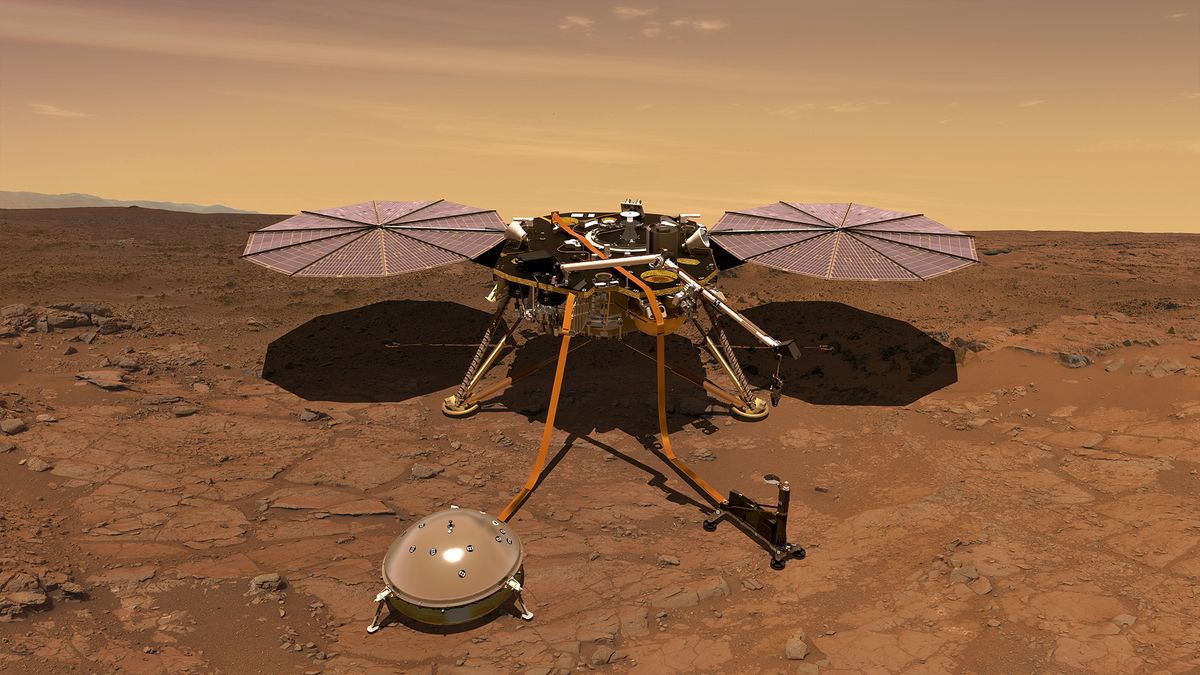
Artist's rendition of the InSight lander on the surface of Mars.(Image credit: NASA)
In 2003, Mars passed closer to Earth than anytime in that past 60,000 years. That same year, NASA launched two rovers, nicknamed Spirit and Opportunity, which explored different regions of the Martian surface. Both rovers found signs that water once flowed on the planet's surface.
In 2008, NASA sent another mission, Phoenix, to land in the northern plains of Mars and search for water whichit succeeded in doing.
In 2011, NASA's Mars Science Laboratory mission sent the Mars Curiosityrover, to investigate Martian rocks and determine the geologic processes that created them. Among the mission's findings was the first meteorite on the surface of the Red Planet. The rover has foundcomplex organic molecules on the surface, as well as seasonal fluctuations in methane concentrations in the atmosphere.
In September 2014, India's Mars Orbiter Mission also reached the Red Planet, making it the fourth nation to successfully enter orbit around Mars.
In November 2018, NASA sent a stationary lander calledMars InSightto the surface. InSight will examine the planet's geologic activity by burrowing a probe underground.
NASA plans to launch a successor rover mission to Curiosity, called Mars 2020. This mission will search for ancient signs of life and, depending on how promising its samples look, it may "cache" the results in safe spots on the Red Planet for a future rover to pick up.
ESA is working on its own ExoMars rover that should also launch in 2020, and will include a drill to go deep into the Red Planet, collecting soil samples from about 2 meters (6.5 feet) deep.
8 .Lost missions
Mars is far from an easy planet to reach. NASA, Russia, the European Space Agency, China, Japan and the Soviet Union collectively lost many spacecraft in their quest to explore the Red Planet. Notable examples include:
1992 — NASA's Mars Observer
1996 — Russia's Mars 96
1998 — NASA's Mars Climate Orbiter, Japan's Nozomi
1999 — NASA's Mars Polar Lander
2003 — ESA's Beagle 2 lander
2011 — Russia's Fobus-Grunt mission to Phobos with the Chinese Yinghuo-1 orbiter
2016 — ESA's Schiaparelli test lander
8 .Human missions to come
Robots aren't the only ones getting a ticket to Mars. A workshop group of scientists from government agencies, academia and industry have determined that a NASA-led manned mission to Mars should be possible by the 2030s. However, in late 2017, the Trump administrationdirected NASA to send people back to the moonbefore going to Mars. NASA is now more focused on a concept called the Lunar Orbital Platform-Gateway that would be a moon-based space station and headquarters for further space exploration.
Robotic missions to the Red Planet have seen much success in the past few decades, but it remains a considerable challenge to get people to Mars. With current rocket technology, it would take several months for people to travel to Mars, and that means they would live for several months in microgravity, which hasdevastating effects on the human body. Performing activities in the moderate gravity on Mars could prove extremely difficult after many months in microgravity. Research on the effects of microgravity continues on the International Space Station.
NASA isn't the only one with Martian astronaut hopefuls. Elon Musk, the founder of SpaceX, has outlinedmultiple concepts to bring people to Mars. In November 2018,Musk rebranded SpaceX's future "Big Falcon Rocket" to "Starship". Other nations, including China and Russia, have also announced their goals for sending humans to Mars.
Three missions are poised to launch toward the Red Planet this month, including NASA's car-sized Perseverance rover, which will hunt for signs of ancient Mars life and cache samples for future return to Earth.
The action will start next week, if all goes according to plan. The United Arab Emirates' (UAE) first-ever interplanetary effort, the Hope Mars mission, also known as the Emirates Mars Mission, is scheduled to launch on July 14.he Hope orbiter will reach Mars in early 2021, then use three science instruments to study the Red Planet's atmosphere, weather and climate from above. The probe's observations should help researchers better understand Mars' long-ago transition from a relatively warm and wet world to the cold, desert planet we know today, mission team members have said. That transition was driven by the stripping of Mars' once-thick atmosphere by the solar wind, the stream of charged particles flowing from the sun.
The Hope spacecraft was built by the UAE's Mohammed bin Rashid Space Center, in partnership with the University of Colorado Boulder, Arizona State University and the University of California Berkeley. And the project is breaking ground for more than just the UAE: Hope is the first planetary science mission led by an Arab-Islamic nation.
China will follow with a landmark launch of its own a little more than a week after Hope takes flight. On July 23, China's first-ever fully homegrown Mars mission, known as Tianwen-1, is scheduled to lift off atop a Long March 5 rocket. (China put a piggyback orbiter called Yinghuo-1 aboard Russia's Mars mission Fobos-Grunt, which got stuck in Earth orbit shortly after its November 2011 launch.)
Tianwen-1 is an ambitious project that consists of an orbiter, a lander and a 530-lb. (240 kilograms) rover that's the size of a small golf cart. Chinese officials have remained characteristically tight-lipped about the mission — they still haven't publicly announced a final landing site for the lander/rover pair, for example — but these robots' scientific gear suggests that Tianwen-1 will conduct a broad reconnaissance of the Martian environment.
The orbiter sports six instruments, including a high-resolution camera, a magnetometer and a mineral spectrometer, which will allow mission team members to determine the composition of surface rocks. The rover also has six instruments, including a weather station, a magnetic field detector and a ground-penetrating radar, which could spot subsurface water ice down to a depth of about 330 feet (100 meters).
If Tianwen-1 is successful, China will become just the third nation, after the Soviet Union and the United States, to land a spacecraft on Mars. And that epic touchdown may lead the way to even bigger things in the near future: Chinese space officials have voiced a desire to mount a Mars sample-return mission, which could perhaps launch as early as 2030.
The United States and Europe also plan to bring pristine Red Planet material to Earth, and that project will really get up and running with Perseverance's launch. The 2,315-lb. (1,050 kg) rover, the centerpiece of NASA's $2.7 billion Mars 2020 mission, is scheduled to lift off atop a United Launch Alliance Atlas V rocket from Florida's Cape Canaveral Air Force Station on July 30 and land inside Mars' Jezero Crater on Feb. 18, 2021.
Perseverance will use its seven onboard instruments to characterize the geology of Jezero and search for signs of ancient Mars life in the rocks of the 28-mile-wide (45 kilometers) crater, which hosted a lake and a river delta billions of years ago.
The six-wheeled robot will also collect and cache several dozen samples from particularly promising study sites. This material will be recovered and brought to Earth, perhaps as early as 2031, in a campaign conducted by NASA and the European Space Agency. Scientists in labs around the world will then scrutinize the Mars material in great detail, looking for signs of life and clues about the planet's evolutionary history.
Mars 2020 also aims to lay groundwork for crewed missions to the Red Planet, the first of which NASA wants to launch in the 2030s. For instance, like the Tianwen-1 rover, Perseverance is outfitted with ice-hunting ground-penetrating radar. And another of the NASA rover's instruments, the Mars Oxygen ISRU Experiment (MOXIE), will generate oxygen from the thin Martian atmosphere, which is 95% carbon dioxide by volume. ("ISRU" stands for "in situ resource utilization." NASA is big on acronyms, in case you hadn't noticed.)
MOXIE isn't Mars 2020's only technology demonstration. A 4-lb. (1.8 kg) helicopter called Ingenuitywill journey to the Red Planet on Perseverance's belly. After touchdown, Ingenuity will drop free and make a few short test flights in the Martian sky — the first-ever aerial exploration of a world beyond Earth.
If Ingenuity is successful, future Mars missions could commonly incorporate helicopters, NASA officials have said. Such rotorcraft could serve a variety of purposes, from scouting out promising study sites for rovers to exploring hard-to-reach areas such as caves or steep-walled craters.
Hope, Tianwen-1 and Mars 2020 all must get off the ground this summer or be put in storage for more than two years, because Earth and Mars align favorably for planetary missions just once every 26 months. And the current launch window isn't open for very long; Mars 2020's closes on Aug. 15, NASA officials have said. (The mission's window originally opened on July 17, but several technical issues have pushed things back to July 30.)
One Mars mission hoping to launch this year has already been packed away until 2022. The life-hunting rover Rosalind Franklin, part of the European-Russian ExoMars program, encountered parachute problems and several other issues that could not be resolved in time for a 2020 liftoff.
There are a lot of reasons for the incredible price tags on artwork. The commissioning and purchasing of artwork has been a major status symbol for the wealthy for all of recorded history. This became especially true after the Renaissance, when merchants and bankers funded the workshops of Michelangelo, Rubens, and more.
Today, the name recognition of certain artists in the public consciousness has greatly increased the value of their work. In some cases, private collectors are so enthusiastic that they won't balk at the cost. Perhaps more often, the constant price increases make art a sensible investment for the wealthy; artwork in private possession is heritable property, often taxed at low rates if at all, and it grows in value at rates faster than many less reliable investments.
Below is a list of the most expensive paintings sold, adjusted for inflation, and their year of purchase.
1 $453 million for Salvator Mundi (Savior of the World), attributed to Leonardo daVinci (2017)Leonardo da Vinci’s depiction of Jesus Christ holding a crystal orb is the most expensive painting in the world!
The painting was commissioned by King Louis XII of France in 1605, during the same period as the Mona Lisa.
However, somewhere between 1763 and 1900, it disappeared from all records until it was rediscovered in 2005, by a group of British art dealers.
Purchasing the painting for $10,000 they spent six years restoring and investigating its history before eventually announcing that it was a Da Vinci original.
The painting was exhibited in 2011 by the National Gallery of London and became known as the “Lost Leonardo”, as it was the first discovery of a Da Vinci since 1909.
The “Savior of the World” (Salvator Mundi) was purchased by the Crown Prince of Saudi Arabia, Mohammed bin Salman on behalf of the Abu Dhabi Department of Culture & Tourism.
2 $312 million for Interchange by Willemde Kooning (2015) Willem de Kooning’s famed 1955 piece was inspired by his surroundings whilst living in NYC and commanded the highest price ever paid in a private sale.
Hedge fund billionaire Kenneth C Griffin bought it alongside his Jackson Pollock Number 17A purchase, in a $500 million deal. Ifyou want to take a look at one of the most expensive paintings in the world, then the “Interchange” is currently displayed at the Art Institute of Chicago.
3 $274 million for The Card Players by PaulCézanne (2011)The third most expensive painting in the world is “The Card Players”, by Paul Cézanna.
It’s one of five paintings included in the French master’s 1890s’ series of the same name.It was purchased by the Royal Family of Qatar in 2011, reportedly paying double the existing record for any artwork to be sold at auction.
4 .$219 million for Nafea Faa Ipoipo (When Will You Marry?) by PaulGauguin (2015)French post-impressionist Paul Gauguin painted this piece when he was on his first trip to Tahiti.
It was one of many he painted of the native woman on the island and its title translates to “When Will You Marry?”.The artwork has also previously been called the most expensive painting in the world, selling for $210 million in 2015 after two years of negotiation.
5 .$208 million for Number 17A by JacksonPollock (2015)This 1948 painting by Jackson Pollock was the second piece of artwork bought in a $500 million deal by hedge fund manager Kenneth C Griffin in 2015.“Number 17A” isn’t on public display at the moment, however, there are many exceptional Pollock collections on display in museums around the world, including the New York’s Museum of Modern Art (MOMA)
Samsung (Korean: 삼성; Hanja: 三星; Korean pronunciation: [samsʌŋ]; means "three stars" in English) is a South Korean multinationalconglomerate headquartered in Samsung Town, Seoul.It comprises numerous affiliated businesses,most of them united under the Samsung brand, and is the largest South Korean chaebol (business conglomerate)., South Korean company that is one of the world’s largest producers of electronic devices. Samsung specializes in the production of a wide variety of consumer and industry electronics, including appliances, digital media devices, semiconductors, memory chips, and integratedsystems. It has become one of the most-recognizable names in technology and produces about a fifth of South Korea’s total exports.
Samsung was founded as a grocery trading store on March 1, 1938, by Lee Byung-Chull. He started his business in Taegu, Korea, trading noodles and other goods produced in and around the city and exporting them to China and its provinces. After the Korean War, Lee expanded his business into textiles and opened the largest woolen mill in Korea. He focused heavily on industrialization with the goal of helping his country redevelop itself after the war. During that period his business benefited from the new protectionist policies adopted by the Korean government, whose aim was to help large domestic conglomerates (chaebol) by shielding them from competition and providing them easy financing.
During the 1970s the company expanded its textile-manufacturing processes to cover the full line of production—from raw materials all the way to the end product—to better compete in the textile industry. New subsidiaries such as Samsung Heavy Industries, Samsung Shipbuilding, and Samsung Precision Company (Samsung Techwin) were established. Also, during the same period, the company started to invest in the heavy, chemical, and petrochemical industries, providing the company a promising growth path.
Samsung first entered the electronics industry in 1969 with several electronics-focused divisions—their first products were black-and-white televisions. During the 1970s the company began to export home electronics products overseas. At that time Samsung was already a major manufacturer in Korea, and it had acquired a 50 percent stake in Korea Semiconductor.
The late 1970s and early ’80s witnessed the rapid expansion of Samsung’s technology businesses. Separate semiconductor and electronics branches were established, and in 1978 an aerospace division was created. Samsung Data Systems (now Samsung SDS) was established in 1985 to serve businesses’ growing need for systems development. That helped Samsung quickly become a leader in information technology services. Samsung also created two research and development institutes that broadened the company’s technology line into electronics, semiconductors, high-polymer chemicals, genetic engineeringtools, telecommunications, aerospace, and nanotechnology.
In the 1990s Samsung continued its expansion into the global electronics markets. Despite its success those years also brought about corporate scandals that afflicted the company, including multiple bribery cases and patent-infringement suits. Nevertheless, the company continued to make advancements on the technology and product-quality fronts, with a number of its technology products—ranging from semiconductors to computer-monitor and LCD screens—climbing into top-five positions in global market share.
The 2000s witnessed the birth of Samsung’s Galaxy smartphone series, which quickly not only became the company’s most-praised product but also frequently topped annual lists of the best-selling smartphones in the world. Since 2006, the company has been the top-selling global manufacturer of televisions. Beginning in 2010, the Galaxy series expanded to tablet computers with the introduction of the Galaxy Tab.
Apple iPhone and Samsung Galaxy Apple's iPhone 4S, left, and Samsung's Galaxy S III, right, displayed at a mobile-phone shop in Seoul, South Korea, August 24, 2012.
The LCD business area focuses on producing TFT-LCD and organic light-emitting diode (OLED) panels for laptops, desktop monitors, and televisions.
Samsung Print was established in 2009 as a separate entity to focus on B2B sales and released a broad range of multifunctional devices and printers and more.As of 2018 Samsung sold their printing business to HP.
Logo history
Samsung Electronics logo, used from late 1969 until replaced in 1979
Samsung Electronics logo, used from late 1980 until replaced in 1992
Samsung Electronics logo, used from late 1993 until replaced in 2015
Samsung's wordmark and current logo of Samsung Electronics, in use since 2015
Samsung and apple war
Despite recent litigation activity, Samsung and Apple have been described as frenemies who share a love-hate relationship. Samsung is a major supplier for Apple – first providing memory for the early iPod devices in 2005,and Apple is a key customer for Samsung – in 2012 its component sales were thought to be worth in the region of $8 billion revenue to Samsung– to the point where Apple CEO Tim Cookoriginally opposed litigation against Samsung wary of the company's critical component supply chain for Apple.
In April 2011, Apple Inc. announced that it was suing Samsung over the design of its Galaxy range of mobile phones. The lawsuit was filed on 15 April 2011 and alleges that Samsung infringed on Apple's trademarks and patents of the iPhone and iPad.Samsung issued a counterclaim against Apple of patent infringement.In August 2011, at The Regional Court of Düsseldorf, Apple was granted a preliminary injunction against the sale and marketing of the Samsung Galaxy Tab 10.1 across the whole of Europe excluding the Netherlands.The ban has been temporarily lifted in the European Union, with the exclusion of Germany, whilst it is investigated whether or not the original injunction was appropriate.
On 31 August 2012, the Tokyo District Court ruled Samsung Electronics' mobile devices did not violate an Apple patent The case only addressed Apple's patent that allows mobile devices and personal computers to synchronize or share data with each other and is not comparable with the U.S. court case ruled on 24 August. On 18 October 2012, the U.K. High Court ruled that Samsung did not infringe Apple's design patents. Apple was forced to issue a court-ordered apology to Samsung on its official U.K. website.




.png&hl=)
.png&hl=)
.svg&hl=)


