On this day 50 years ago, three astronauts began their journey to the moon.
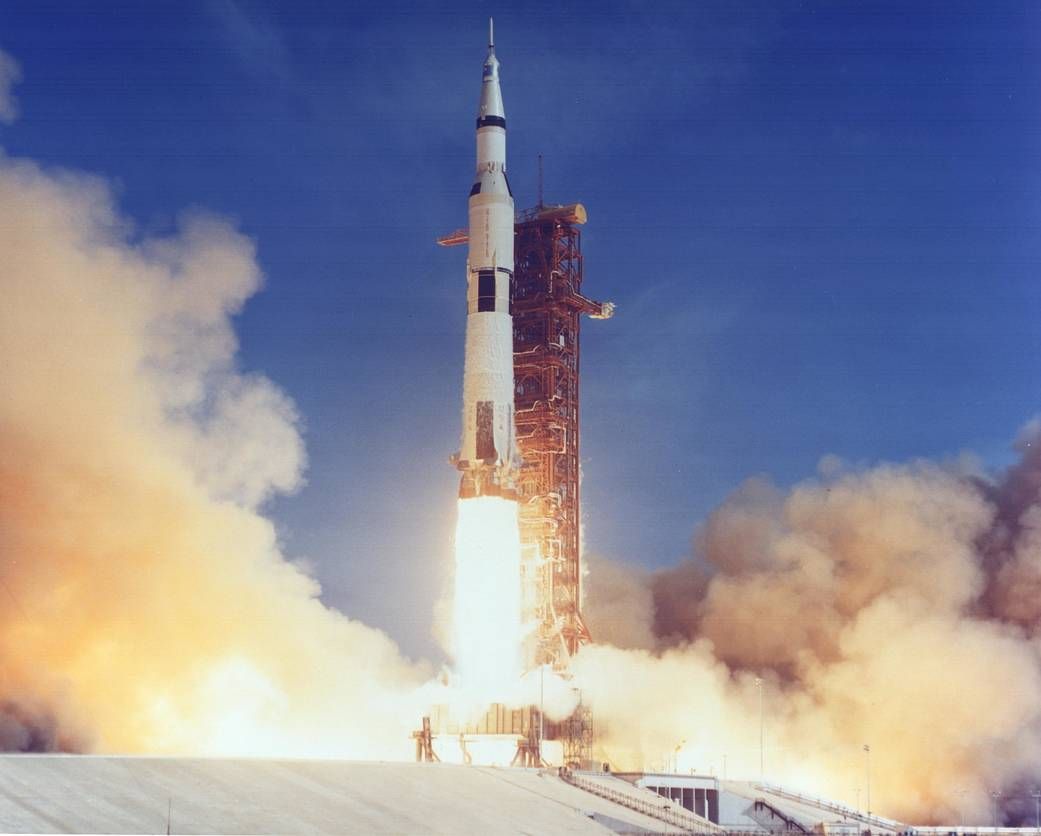
NASA's Saturn V rocket launched the Apollo 11 astronauts towards the moon on July 16, 1969. (Image credit: NASA
The first Moon landing is a story littered with big numbers. It took eight years, 10 practice-run missions, more than 400,000 engineers, scientists and technicians, and in today’s money roughly £150 billion to make the first tentative steps on another planetary body.
By pushing the limits of the most advanced technologies of the time, NASA achieved President John F Kennedy’s 1961 national goal of sending an American to the Moon before the end of the decade. But how did the astronauts actually get there?
Five days before stepping on the Moon, on the morning of 16 July 1969, Commander Neil Armstrong, Command Module Pilot Michael Collins and Lunar Module Pilot Edwin ‘Buzz’ Aldrin were still here on Earth. They were doing final checks inside the tiny Columbia command module. No roomier than the interior of a large car, Columbia would serve as their living quarters throughout the journey.
This module sat at the very top of a 111 metre-tall Saturn V rocket. The most powerful rocket to ever fly, the Saturn V had three stages. Each stage would burn its engines until it was out of fuel and then separate from the rocket. The engines on the next stage would then fire, and the rocket would continue into space.
At 9.32 am local time, the first stage ignited and the rocket launched from Cape Kennedy. With the challenging task of lifting the heavy spacecraft off the ground, this stage was all about delivering power. It used a liquid hydrogen and oxygen mixture that was far from economical, getting through 18,000 kilograms of fuel per second. But it was effective, producing 3.4 million kilograms of thrust for about 2.5 minutes, and propelling the astronauts to an altitude of 68 kilometres the first stage, which fell into the Atlantic Ocean. After dropping the interstage skirt and the launch escape tower, the rocket dropped its second stage. Just ten seconds later, the third stage engine ignited and, just 11 minutes and 39 seconds after launch, the spacecraft reached an elliptical orbit around Earth, traveling at 17,432 mph (28,000 kph).
The spacecraft carried the Apollo 11 crew, along with fuel tanks, fuel cells, tanks of oxygen and hydrogen, supplies and food for the crew, cameras, the Early Apollo Scientific Experiment package, additional scientific instruments and equipment, and tools for collecting samples on the lunar surface.
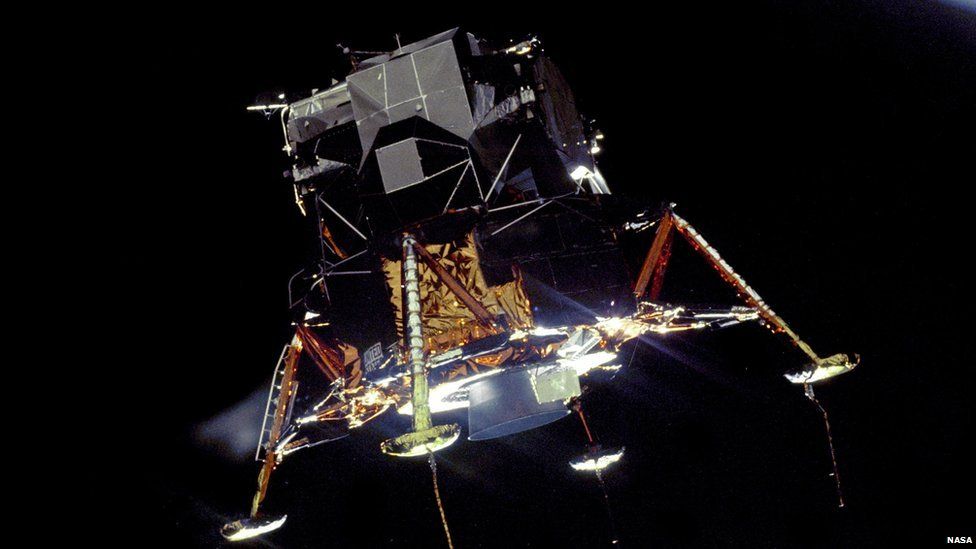
As the astronauts in the command module orbited the Earth, the lunar module, known affectionately as the Eagle, was nestled safely underneath them. Just a few days after launching from Florida, Armstrong and Aldrin would land the Eagle at the Sea of Tranquility on the moon and step out onto the surface of our rocky satellite.
The rocket:
Saturn V is still the largest and most powerful rocket ever built
Standing at more than 100m (363ft), the Saturn V rocket burned some 20 tonnes of fuel a second at launch. Propellant accounted for 85% of its overall weight.
Saturn V Diagram
Diagram of the Saturn V showing launch configuration for Apollo lunar landing missions.
NASA
When Apollo began, neither the United States nor the Soviet Union possessed a rocket powerful enough to send humans to the Moon and back. Both the Americans and the Soviets had to develop a super-booster, or Moon rocket. The United States succeeded with the mighty Saturn V.
Saturn V is the largest rocket booster ever built by the United States. This rocket, a 3-stage, liquid-fueled launch vehicle, was designed to propel a crew of three astronauts and Apollo spacecraft on their way to the Moon. These giant rockets were used only 11 times, on Apollo missions 8 through 17 and for the Skylab Orbital Workshop.
Rocket Specifications
Height: 110 meters (363 feet)
Weight at liftoff: 2,767,000 kilograms (6,100,000 pounds)
Thrust at liftoff: 33.4 million newtons (3.4 million kilograms; 7.5 million pounds)
Developed by: Dr. Wernher von Braun at NASA's George C. Marshall Space Flight Center, Huntsville, Alabama
F-1 Engine
The F-1 engine was developed to provide propulsion for the Saturn V rocket used during the Apollo lunar landing missions. Developed during the early 1960s, the Saturn V rocket was the largest rocket in the world and the F-1 was the most powerful rocket engine.
The first of the 3 stages of the Saturn Rocket (S-IC) was powered by a cluster of five F-1 engines developing a total of 33.4 million newtons (3.4 million kilograms; 7.5 million pounds) of thrust at liftoff. They burned 2,021,000 liters (534,000 gallons) of liquid propellants in the 2½ minutes before first stage burnout. By then the big rocket had reached 9,660 kilometers per hour (6,000 miles per hour) and an altitude of 61 kilometers (38 miles).
Engine Specifications
Length: 5.6 meters (18 feet 4 inches)
Maximum diameter: 5.6 meters (11 feet 11 inches)
Weight: 8200 kilograms (18,000 pounds)
Maximum thrust at sea level: 690,000 kilograms (1,522,000 pounds)
Propellants: Liquid oxygen and kerosene
Manufacturer: Rocketdyne, A Division of North American Rockwell Corporation
The five clustered F-1 engines provided propulsion solely for the first stage of the rocket, while J-2 engines provided propulsion for both upper stages (five on the S-II second stage, one on the S-IVB third stage).
One of the five F-1 engines used to power the Saturn V rocket.
The aft end of the Saturn rocket, laying on its side. This shows the cluster of five F-1 engines that fueled the first stage of the rocket.
Diagram of the F-1 engine in its upright position.
On display at the museum stands one full F-1 engine and a quarter of an engine. A mirror arrangement gives the appearance of the full 5-engine cluster.
Launch Vehicle Crawler-Transporter
The Apollo Launch Vehicle Crawler-Transporter was a large moving platform that transported the Saturn V rocket from the VAB (Vehicle Assembly Building) to the launch pad for the Apollo missions. It was used at the Kennedy Space Center, Florida, during the Apollo program of the 1960s and '70s.
Launch Vehicle Transporter Specifications
Length: 40 meters (131 feet)
Width: 35 meters (114 feet)
Height: 6 meters (20 feet)
Weight: 2,721,554 kilograms (6,000,000 pounds)
Carried: Saturn V weighing 272,160 kilograms (600,000 pounds) and its massive Launch Umbilical Tower weighing 5,443,200 (12,000,000 pounds)
Maximum speed when loaded: 1.6 kilometers per hour (1 mile per hour)
About the lunar module
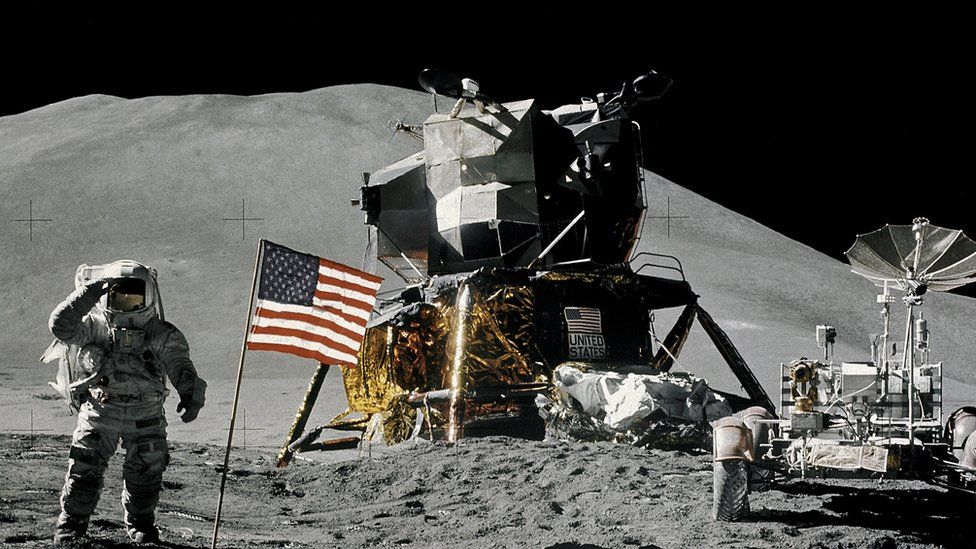
A total of 10 lunar modules were sent into space and six landed humans on the moon.
Image copyrightNASA
Image captionApollo 11's Lunar Module 'Eagle' begins its descent to the lunar surface
Once used, the ascent stages of the capsules were jettisoned and either crash-landed on the moon, burned up in Earth's atmosphere, or - in one instance - went into orbit around the Sun.
What happened to the Lunar Modules?. . * Apollo 13's LM was used to help return the mission to Earth after an explosion damaged the Service Module.
The first two Lunar Modules were used in test flights and burned up in Earth's atmosphere.
Apollo 10's Lunar Module, which went to the Moon but didn't land, was jettisoned into space and went into orbit around the Sun.
Apollo 13's Lunar Module performed a vital "lifeboat" role when that mission had to be aborted following an explosion.
Most of the other modules - once they had safely returned astronauts back to the Command Module in lunar orbit - were dispatched to crash-land back on the surface.
The crash sites of most are known - but no-one is quite sure where the ascent stages of Apollo 11's module Eagle or Apollo 16's module Orion ended up




No comments:
Post a Comment