


The city that survived the world's first atomic bombing marked the 75th anniversary of the attack in Japan on Thursday, with Hiroshima Mayor Kazumi Matsui urging nations to reject self-centered nationalism and commit more seriously to nuclear disarmament.

In a ceremony sharply downsized due to the coronavirus pandemic, survivors, their relatives, and officials stood for a moment of silence as cicadas shrilled in the heavy summer heat and the Peace Bell rang out over Peace Park.
"On August 6, 1945, a single atomic bomb destroyed our city. Rumor at the time had it that 'nothing will grow here for 75 years'," Matsui said at the memorial ceremony.
"And yet, Hiroshima recovered, becoming a symbol of peace."
The mayor went on to urge Japanese Prime Minister Shinzo Abe's government to sign the international treaty banning nuclear weapons and called on the world to unite in the face of global threats.
"When the 1918 flu pandemic attacked a century ago, it took tens of millions of lives and terrorized the world because nations fighting World War I were unable to meet the threat together," Matsui said.
"A subsequent surge in nationalism led to World War II and the atomic bombings. We must never allow this painful past to repeat itself. Civil society must reject self-centered nationalism and unite against all threats."
Below we take a look at the events that devastated Hiroshima and ushered in the era of weapons of mass destruction.
What happened in Hiroshima?
On August 6, 1945, at about 8:15 am local time, the US aircraft Enola Gay dropped an untested uranium-235 gun-assembly bomb nicknamed "Little Boy" over Hiroshima.
The destruction was unlike anything in the history of warfare.
Hiroshima was immediately flattened. The resulting explosion killed 70,000 people instantly; by December 1945, the death toll had risen to some 140,000.
The radius of total destruction was is reportedly 1.6km.
"The impact of the bomb was so terrific that practically all living things - human and animal - were literally seared to death by the tremendous heat and pressure set up by the blast," Tokyo radio said in the aftermath of the explosion, according to a report by The Guardian in August 1945.
"All the dead and injured were burned beyond recognition. Those outdoors were burned to death, while those indoors were killed by the indescribable pressure and heat."
But the damage did not end there. The radiation released from the explosion kept causing suffering.
Thousands more died from their injuries, radiation sickness, and cancer in the years that followed, bringing the toll closer to 200,000, according to the Department of Energy's history of the Manhattan Project.
Three days later a second nuclear weapon was dropped on Nagasaki. Two weeks later Japan surrendered, ending World War Two.
Why did the US drop the bomb?
Japan was a fierce enemy of the US and its allies, Britain, China, and the Soviet Union during World War II.
By 1945, the allies had turned the tide of the war and pushed the Japanese forces back from many locations.
The Japanese had publicly stated their intent to fight to the bitter end and were using tactics such as kamikaze attacks, suicide attacks by Japanese fighter pilots against US warships.
In July 1945, US President Harry Truman and allies demanded the "immediate and unconditional"surrender of Japan, but Japan did not issue a clear response.
Shortly after, the US attacked Hiroshima, chosen because it was seen as a "strategically sound" target based on calculations around weather conditions, aircraft range, military impact, and the impact on "enemy morale".
Early on Thursday, Japan's Prime Minister Shinzo Abe and the mayor of Hiroshima joined bomb survivors and descendants in the city's Peace Park.
The park is usually packed with thousands of people for the anniversary, But attendance was significantly reduced this year, with chairs spaced apart and most attendees wearing masks.
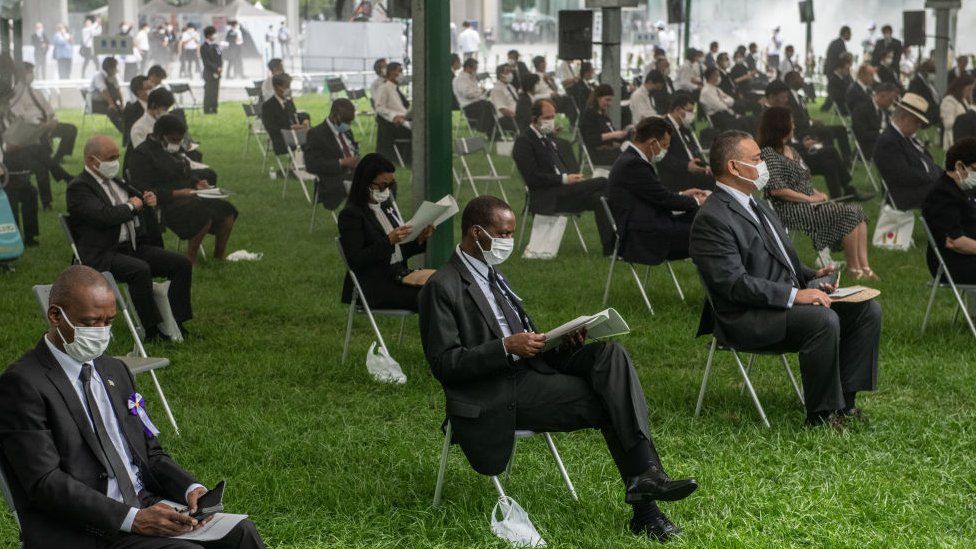
A moment's silence was held at 08:15, the exact time the bomb was dropped on the city.
"On August 6, 1945, a single atomic bomb destroyed our city. Rumor at the time had it that 'nothing will grow here for 75 years,'" Mayor Kazumi Matsui said. "And yet, Hiroshima recovered, becoming a symbol of peace."


No comments:
Post a Comment